It is important to bring the importance of occupational health and safety to light from a public health perspective. The most surprising statistic from the lecture video is that every 15 seconds a worker dies from a worker-related injury or illness, or 2.3 million people per year. The most common physical hazards are tripping, slipping, falling; ergonomic problems; heat and cold; fires and explosions; abrasions, cuts, punctures, and lacerations; amputations and motor vehicle accidents. As well, as these physical hazards, there are also chemical, biological, and radiological workplace exposures varying on the location of work. These exposures can be pathogenic exposures for healthcare facility workers and laboratory scientists to radiation in nuclear power plant workers or mineworkers. One of the most famous work-related illnesses is black lung disease, which results to the over exposure of coal dust.
A very resourceful takeaway from the lecture video is the "Hierarchy of Controls" as seen below:
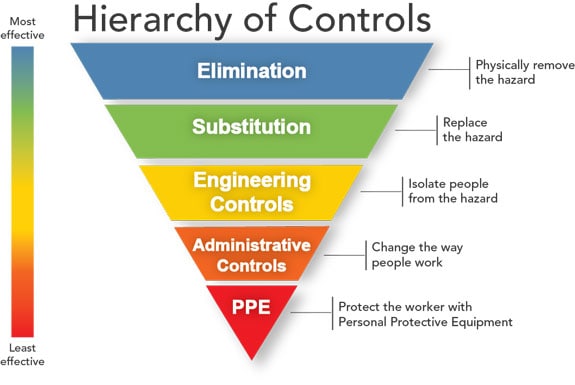
This diagram is straight-forward and explicitly states the most effective way to limit health hazards to workers.
Three exposure terminologies those in occupational health and safety need to familiarize themselves with are:
- permissible exposure limit - the legal limit set by OSHA for a chemical exposure or noise level
- Time-weighted average - average exposure over the course of a normal 8-hour day
- Threshold limit value - the amount of an exposure that a worker can be exposed to day after day without harm
OSHA is the Occupational Safety and Health Administration was created to assure safe and healthful working conditions for working men and women by setting and enforcing standards and by providing training, outreach, education, and assistance.
The most striking example of OSHA standards given in the video is the bloodborne pathogens example.
A bloodborne pathogen is a microorganism that causes disease and is present in human blood. The most common diseases are Hepatitis B and HIV. In all cases of bloodborne pathogens, OSHA creates a standard by first determining risk for exposure, implements an exposure reduction plan (that involves universal precautions, engineering controls, and PPE), and training/education

Bloodborne pathogens is an important topic to discuss in healthcare settings and is an area of healthcare that requires careful training beyond the physical aspects. Healthcare providers need to be appropriately coached with regards to their approach in conversation with patients. In this way, health providers can address any patient concerns about any PPE or other protective actions that will minimize harm for everyone.
ReplyDeleteBeing compliant with OSHA standards is the best way to protect employees in the work place, along with trainings and bringing awareness to the potential harm if exposed to chemicals, and anything else that may cause injury.
ReplyDelete